
This post first went live in 2019, and since then it has bounced around the internet under the tongue-in-cheek title: “the fastest website in the world.”
Back then, it was a bit of a joke. But a useful one. Because while there’s no single “fastest” website, there are proven methods to make your site perform at the very top end of what’s possible.
In 2025, I’ve updated this post again. Why? Because speed still matters:
- Search engines still reward fast sites.
- Conversions still improve with every millisecond saved.
- And in the age of AI, fast, cleanly structured websites get scraped and surfaced more.
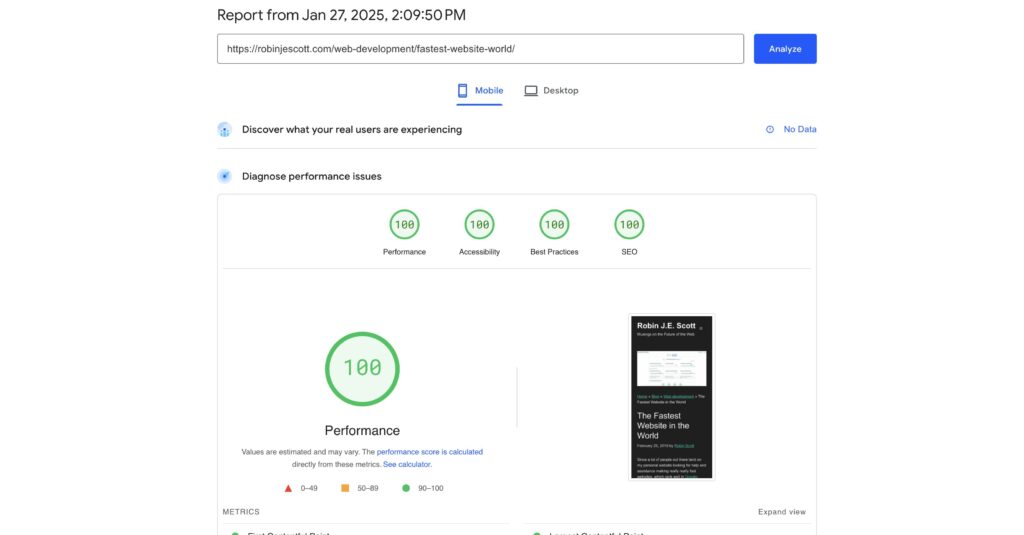
So, What’s the Fastest Website in the World?
Well… ours.
Every site my teams and I build — whether at Silicon Dales or Copiq — is engineered with speed at its core.
We’re not talking about bare-bones HTML gimmicks. These are real sites: content-heavy, eCommerce-ready, enterprise-scale. And they still consistently score:
- ⚡ Quadruple 100s in PageSpeed Insights
- ⚡ Sub-second load times worldwide
- ⚡ “A” grades across Lighthouse, WebPageTest and GTmetrix
(I’ll drop a video here soon comparing several of our live builds — spoiler: they all crush the so-called “fastest website” demos on YouTube.)
How We Do It (and How You Can Too)
The principles haven’t changed — but the tools have. Here’s the 2025 version:
- Hosting – Cloudflare APO, AWS, or top-tier managed hosts. Avoid shared hosting like the plague.
- Stack – WordPress + GeneratePress/FSE + custom blocks. PHP 8.3+, MariaDB 10+, Nginx.
- DNS – Route 53 or Cloudflare for global propagation. Long TTLs, short lag.
- Code – Lightweight themes, minimal plugins, and ruthless plugin audits.
- Assets – Images in AVIF/WebP, lazy-loaded. Fonts subsetted. JS deferred. CSS trimmed.
- Caching/CDN – Nginx micro-cache, object caching, Cloudflare APO/Argo smart routing.
- Measurement – Test with Lighthouse, WebPageTest, and CrUX field data (not just lab).
Why This Matters in 2025
Five years ago, having a fast website was about ranking well. Today, it’s also about:
- AI integration – AI scrapers prefer clean, fast, structured sites.
- Global users – latency and performance matter more when your customers are everywhere.
- Trust – slow, bloated sites signal sloppiness; fast sites signal competence.
Want the Fastest Website?
- That’s what we build at Silicon Dales.
- That’s why we built Copiq to scale content without slowing down.
Whether you’re running a single brand site or an entire content network, speed isn’t an afterthought — it’s the foundation.
So yes, technically, the fastest website in the world is the one we just launched.
FAQs?
People always ask me these questions… actually, they do not. They Google search “the fastest website on Earth” then get angry and leave a comment (scroll down if you don’t believe me) but nevertheless, I’ve framed some Q and As below in case these chime with the silent majority of people just looking for tips.
What software to use?
Choose a fast framework or software (WordPress is a good choice)
Where to host it?
Choose a fast host (see my post on best WooCommerce hosting – the recommendations in there are fast)
What add-ons, extensions, themes or plugins should I add?
Don’t add plugins or frameworks which are bloated or perform “slowly” (test them!). This extends to the theme (template) and all front-end plugins. Use Google Lighthouse on demo sites (or stand up your own demo site and test this). If it’s not fast out of the box, you’ll struggle to keep it fast.
What about images?
Optimize your images – and serve them in “next gen” formats, like Webp – so they are as small as possible.
Any more advanced tricks?
Lazy load elements which are unseen without scrolling – someone who doesn’t scroll won’t need to load this stuff (this includes images, CSS, js and etc)
What about mobile performance?
Think mobile first – consider AMP (yeah, there’s some issues, but it is blazing fast). You’ll therefore need to make sure your website is getting all green scores on Google’s Pagespeed Insights for mobile in the lab AND in reality.
Any final thoughts and tips?
Cut out the cruft generally – optimization is a way of thinking, not just some magic bullet. Think about how to say what you need to say as fast as possible. Don’t add huge images when a small logo will do the trick. Don’t load 8 tracking scripts before a page has even rendered, if you must collect analytics, make sure you really are using that data, or remove the script altogether (best) or defer or load it after a user interaction (reasonable). Marketing technology is beneficial, but don’t slow down every user for that HotJar screen recorder you haven’t actually looked at since 2023.
Please note, this piece is deliberately vague. I’m focussing on choices you will need to make, not technical solutions. There’s plenty of tutorials out there – I’ve posted a lot of them myself. This is a slightly wider view about what fast is, and how to get there.
An interesting discussion is worth comment. I think that you should publish more about this subject, it may
not be a taboo subject but generally folks don’t discuss such topics.
To the next! Kind regards!!
Thank you for this article, it has sound advice. Check out the speed on https://edgy.app, it’s insanely optimized! We spent 2 months on just optimization.
Optimization is never finished 😛 – but totally worth it. Nice work.
I love that you’ve written a wide approached article to building a fast site.
I am obsessed with site speed and have found litespeed servers to be insanely fast…
For example, i have litespeed server with litespeed cache partnered with cloudflare static caching cdn. In the UK on Chrome, Safari etc and on pingdom my site loads in just over half a second on the homepage….
Not that impressive, but…
My huge 11mb webpage on google algorithm updates loads in 0.6 seconds with the above stack;
No VPS, just a decent cloud hosting in the UK.
In the coming years and the move away from pc, page site speed is going to become ever more important for both UX and SEO.
Mobile is substantially slower and thus, you need insanely fast desktop load times just to buffer then inevitable drop when a user visits a site on mobile.
But yeah, i might be a little insane like you for page speed 🙂
All the best,
Adam
Yeah Litespeed is usually better than Apache for speed. It generally performs a little slower than straight Nginx (and is also proprietary rather than open source too).
Most people seem to compare Nginx + Apache with Litespeed, which is an unfavourable comparison.
Compare it with a LEMP stack, with no Apache, and you’ll find Nginx is a clear winner.
Does updating to php 7 can cause any damage to my wordpress website?
Hi Asif,
Upgrading to PHP 7, wouldn’t “damage” your site, but some of your plugin or theme files might not be compatible, and this would cause an error, and in some cases, lead to a white screen (i.e. your site not working). You would want to check and resolve these errors BEFORE you upgraded.
There’s a plugin called “PHP Compatibility Checker” which is in the WP repo (it’s made by WP Engine) which can help with this, or I would also recommend posting a task for a developer to test and confirm this before you make the switch, if you’re not comfortable with this.
Forgot to mention…
QUIC CLOUD (a litespeed cdn) is in beta currently that does both dynamic cdn caching (php etc) AND static cdn caching which is insanely fast….
I have tested it and using lscache, litespeed server, and quic cdn (dynamic and static caching) is substantially faster than lscache, litespeed server, and cloudflare static.
Give it try! My only recommendation is use it on test sites currently as it is in beta and i have experienced some bugs which have made me revert to cloudflare cdn until quic cloud is out of beta.
All the best,
Adam
Please note, this website is now a little faster than when this was originally posted.
It would be the fastest if you didn’t have 400kb of fonts loading! 🙂
To be honest, there’s this misconception that you can’t get fast speeds unless you shun shared hosting, but you can easily get 0.5 seconds using shared hosting and Cloudflare/Stackpath.
It’s all in the details or micro-optimisations, as you’d say.
Recently I got a perfect score on Lighthouse Chrome DevTools and revealed a Google Easter Egg. This is on an AMP site, but AMP is in fact SLOWER unless it’s served from an AMP cache by Google or Cloudflare.
Now just setting up a new site that’s regular WordPress, using GeneratePress and Elementor, as that’s the lightest combo I can find at 27.3 kb for stock WordPress and Premium GP.
For comparrison, stock Themify Ultra which includes Themify Builder is 160kb. To be fair to Themify, it’s easy to turn things off so it loads lighter, but why waste code turning features off? It’s like a double waste.
Good work, though. Thanks for the read.
This is currently running the alpha version of WordPress 5.4, and as a consequence, you will see it has the fonts loading from the 1.0 version of Twenty Twenty theme, unadulterated. i.e. anyone can achieve this, with stock theme. Removing the fonts would obviously make the overall payload lower. There’s a trade-off to be made there, similar to that described in the post itself. Most clients and end-users are selective and will have an opinion about fonts.
Ideally, I’d host a white page with only text, in arial 😉
omg, propagation of WP which is slow and not secure system, all is lie here..i create website over 10y in PHP and WP is my enemy..it’s for amaters..WP made just trash on internet
I’ve approved this comment because you just filled my bingo card 🙂
1) WordPress is slow – well, obviously not… how you landed here is you searched up the fastest website.
2) WordPress is not secure – nope. That’s like saying houses are not secure. Security is the job of the system administrator.
3) WordPress is for amateurs. No. I earn a very good living using WordPress every day.
WordPress is built with PHP. Just because you don’t like a tool doesn’t mean it isn’t useful. It doesn’t suit all purposes, but WordPress can load very fast, in professional hands.
Thank you for completing my Full House on the myths about WP bingo card. I feel like a big winner for Wednesday now 🙂
I did a post about page loading times as I was excited that on day 1 of first deployment and design of a new blog. I then did a search for “fastest website in the world” and guess what? I was very pleased with your article. I’m actually going to be moving my personal projects to a VM I have at a datacentre just 5 mins from my house in Manchester soon and the provider recommends a LEMP stack as it happens, and I couldn’t be happier with exploring this and moving my personal projects over in this way initially as I learn more about Nginx and Maria DB. I’ve downloaded Heidi SQL locally also on recommendation. Anyways, I love all the comments and esp. your replies! Really nailed it here for me, happy days!
OK, so plug time (if you’ll allow) I’d like to say that I put a link to your post as a comment on my recent blog post.
So without further adue, here is my post about page loading times:
https://dredevops.com/need-for-speed/
Info: I’m using the Hello theme from Elementor which is one of the fastest vanilla themes that I know of but I haven’t even started my optimisation journey yet. I’m excited get a result of 259 ms initially! Godspeed!
Hi Dre,
Best of luck! Elementor is a pretty good pagebuilder when it comes to optimization.
Be sure to check out AMP project – when it comes to Google’s PageSpeed Insights, you’ll find an all AMP site will score really high. I know not everyone loves AMP, but… well Google has some authority in the space. They are all-in on AMP.
Thank you Robin, much appreciated.
I was just searching to see if my post came up in the results for my own keywords, and yours showed up before mine ha ha! It reminded me to check and reply.
Aye, I would have seldom touched a page builder with a barge pole, then Elementor came along and changed the game.
I regularly attend the monthly Elementor and WordPress User Group meetups here in Manchester, which are of course online now (accessible to all).
In this month’s MWUG run by Mike Little (co-founder of WP) he talked about AMP and it seems certain that Google will favour an AMP story over a non-AMP story amongst other things. I’m glad you’ve mentioned it again, as it has prompted me to actually look into this framework. Exciting stuff!
First things first, I’m going to start looking into moving from Apache/Litespeed and MySQL to pure Nginx and Maria DB on recommendation from a provider that I trust who has provisioned me a CentOS VM which I’m going to play around with initiall (as I’m more familar with Ubuntu/Debian) and I’m fairly new to working at the command-line level without a panel/GUI. I may consider Plesk at some stage as a more “responsible” way to manage commercial projects whilst I’m learning as I want to move away from cPanel entirely (who needs such a bloated system right?)
p.s. It’s safe to say I’m a fan of yours now, as I can’t really fault a single thing you’ve said on this post and I love how you deal with and respond to comments. BINGO! 😉
Your method of describing the whole thing in this article is in fact
fastidious, all can easily know it, Thanks a lot.
It’s great to see this page is alive and kicking, with updates and further discussion to boot. I actually have come full circle now, having just commented on another post of yours about commenting, which led me to actually view your posts in chronological order to get a better picture. Turns out that post was more outdated than I’d realised in my need for haste. I’ve actually been somewhat inspired by your content, even when not obsessively perusing the contentful pain(t) of fellow too many websites for a Saturday morning.
This professional might advise on retaining or removing particular furniture items. They’ll give insights for improving both the indoor and outdoor appearance to draw to possible visitors. The services include snapping top-notch pictures and crafting enticing narratives to emphasize significant elements. Moreover, they place your own ad on a well-known property platform.
Hey people!!!!!
Good mood and good luck to everyone!!!!!